Small Business Startup Loans For Veterans Guide 2026
You led teams in combat. Now it's time to lead your own business, and the funding is waiting.
Here's the reality most veterans don't know: there's over $30 billion in available funding specifically designed for veteran entrepreneurs. Yet less than 8% of transitioning service members take advantage of these programs.
Whether you're fresh out of the service or years into civilian life, small business startup loans for veterans offer unprecedented access to capital with better terms, lower fees, and faster approval than traditional business loans.
This guide walks you through every veteran business loan option available in 2026, eligibility requirements, application strategies, and low-cost business ideas perfect for leveraging this funding.
By the end, you'll know exactly which programs fit your business model and how to apply with confidence.
Ready to turn your service into entrepreneurial success? Book a free strategy call to create your personalized funding roadmap.
Why Veterans Have a Unique Advantage in Securing Business Funding?
The Statistics That Prove Veteran Entrepreneurship Works
The numbers don't lie. According to the SBA Office of Veterans Business Development, veteran-owned businesses have a 9% higher survival rate compared to non-veteran businesses. That's not luck, it's the direct result of military discipline, strategic thinking, and mission-focused execution.
Currently, 2.5 million veteran-owned businesses contribute $1.3 trillion annually to the U.S. economy. These businesses employ over 5.8 million people and represent one of the fastest-growing segments of American entrepreneurship.
The connection is clear: military discipline translates directly to business discipline. The same planning, execution, and accountability systems that worked in your military career become your competitive business advantage. This is exactly why The 8th Ascent System was built to give veterans the structured framework they need to execute.
Federal Programs Designed Specifically for You
The federal government recognizes this potential, which is why they've created multiple programs exclusively for veteran entrepreneurs:
Service-Disabled Veteran-Owned Small Business (SDVOSB) Certification opens doors to over $100 billion in federal contracting set-asides annually. This certification gives you preferential treatment when bidding on government contracts.
SBA Veterans Advantage eliminates or reduces fees on certain loan programs, potentially saving you $3,000-$15,000 in upfront costs.
Veteran-specific grants and accelerators provide both capital and mentorship without requiring repayment.
These aren't handouts; they're recognition of your service and investment in your ability to build successful businesses that strengthen the economy.
The 12 Best Small Business Startup Loans for Veterans in 2026
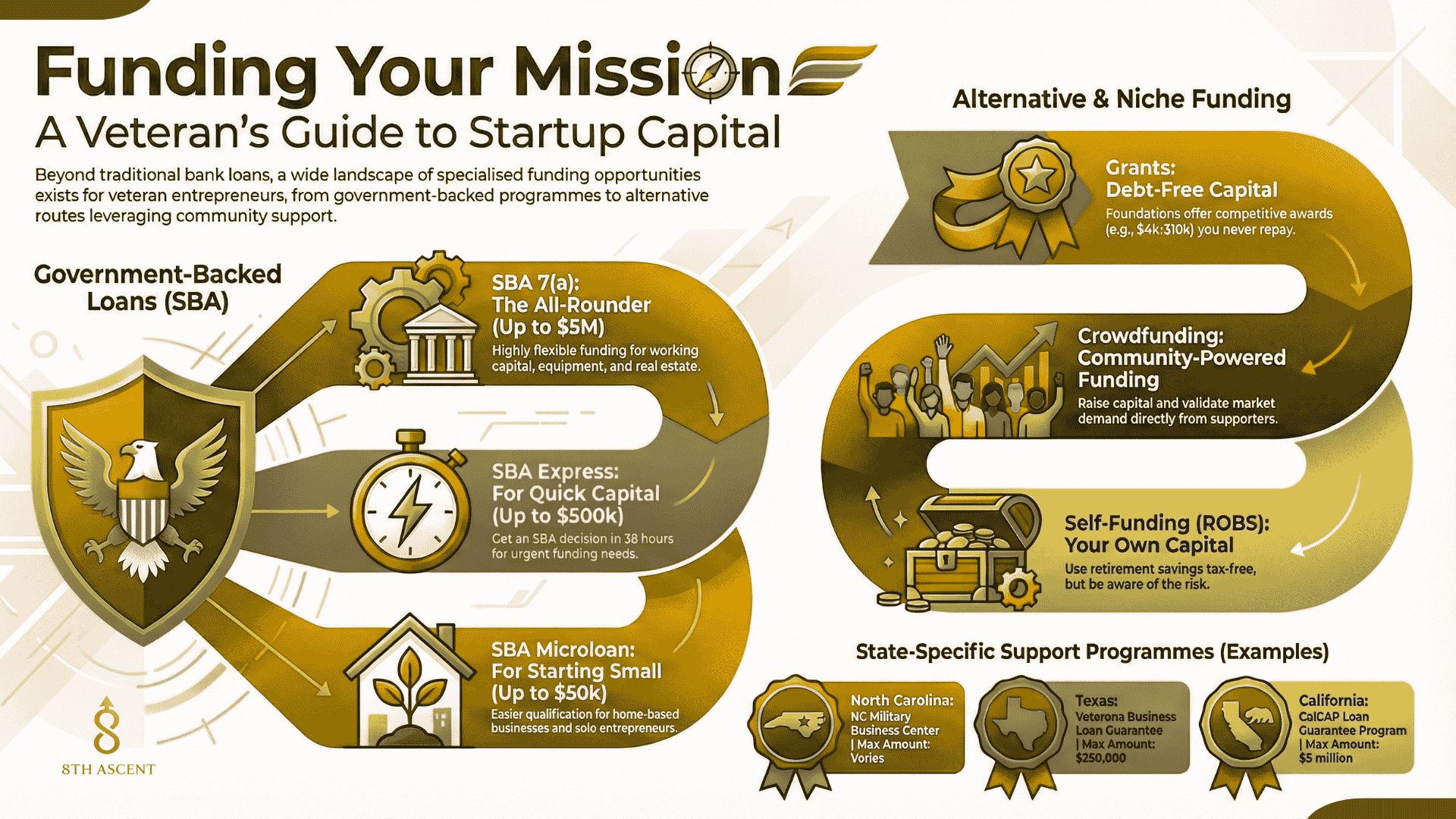
1. SBA Veterans Advantage Loan (7(a) Loan Program)
The SBA 7(a) loan program is the most popular choice for veteran entrepreneurs, and for good reason.
Loan Amount: Up to $5 million
Interest Rates: 11.5%-14.5% (variable based on creditworthiness)
Veteran Benefit: Fee waivers that save thousands in upfront costs
Best For: Service-based businesses, retail stores, professional services, restaurants
Eligibility Requirements:
DD-214 or equivalent military service documentation
Business plan with financial projections
Personal credit score of 650 or higher
Demonstrated ability to repay
Application Timeline: Expect 60-90 days from application to funding
Where to Apply: Find SBA-approved lenders in your area through the SBA Lender Match tool.
The 7(a) program offers the most flexibility in how you use funds, working capital, equipment purchases, real estate, refinancing debt, or inventory.
2. SBA Express Loan for Veterans
The Express loan provides faster approval for smaller loan amounts.
Loan Amount: Up to $500,000
Interest Rates: Typically 1-2% higher than standard 7(a) loans
Veteran Benefit: Expedited review process
Best For: Quick capital needs, established businesses needing working capital
Application Timeline: 36 hours for SBA decision (total funding 30-45 days)
This program sacrifices slightly better rates for speed. If you need capital quickly and qualify, it's worth the premium.
3. Military Reservist Economic Injury Disaster Loan (MREIDL)
This specialized program from the SBA's disaster loan program helps businesses impacted when an essential employee is called to active duty.
Loan Amount: Up to $2 million
Interest Rate: 4% (as of 2026)
Best For: Reserve and National Guard member business owners
Unique Feature: Covers operating expenses during deployment
If you're a reservist or have key employees who are reservists, this low-interest option can bridge the gap during active duty periods.
4. SBA Microloan Program
Perfect for low-cost startup ventures, the SBA Microloan program connects veterans with community-based lenders.
Loan Amount: Up to $50,000 (average loan is $13,000)
Interest Rates: 8%-13%
Best For: Very small startups, home-based businesses, solo entrepreneurs
Advantage: Easier qualification requirements than traditional loans
Many microloan intermediaries offer business training and technical assistance alongside funding.
5. State-Level Veteran Business Loan Programs
Many states offer additional veteran business loan programs. Here are notable examples:
North Carolina
Varies
Free consulting + loan connections
Texas
Veterans Business Loan Guarantee
$250,000
State-backed guarantee reduces lender risk
California
CalCAP Loan Guarantee Program
$5 million
Up to 80% guarantee
Florida
Veterans Florida Entrepreneurship Program
Varies
Training + capital connections
For Charlotte-area veterans: The NC Military Business Center provides free consulting and connects you with lenders familiar with veteran business funding.
6. Veteran Business Fund Micro-Loans
The Veteran Business Fund offers microloans specifically to veteran entrepreneurs who might not qualify for traditional financing.
Loan Amount: $500-$50,000
Interest Rates: Competitive with traditional microloans
Best For: Startups without extensive credit history
Application: Online process with faster turnaround than SBA programs
7. StreetShares Foundation (Grants, Not Loans)
While technically grants rather than loans, StreetShares Foundation awards veteran entrepreneurs with capital they never have to repay.
Award Amount: Typically $4,000-$10,000
Frequency: Monthly competitions
Requirements: Veteran-owned business, compelling business story
Application: Online submission with business plan and pitch video
These are competitive, but worth 30 minutes to apply. Free money beats loans every time.
8. Equipment Financing
If your business requires specialized equipment (such as vehicles, machinery, or technology), equipment financing provides an alternative to traditional loans.
Loan Amount: Varies based on equipment value
Terms: Equipment serves as collateral
Best For: Construction, transportation, manufacturing, and medical practices
Veteran Advantage: Some lenders offer preferential rates
The equipment itself secures the loan, making approval easier even with limited business history.
9. Invoice Factoring
For service-based businesses with B2B clients, invoice factoring provides immediate cash flow.
How It Works: Sell your unpaid invoices at a discount (typically 80-90% of value)
Best For: Established businesses with slow-paying clients
Speed: Funding within 24-48 hours
Not technically a loan: No debt on your balance sheet
This isn't ideal for startups, but it solves cash flow problems for growing service businesses.
10. Crowdfunding Platforms
Platforms like Kickstarter, Indiegogo, and veteran-focused Rally Point allow you to raise capital directly from supporters.
Amount Raised: Varies wildly ($5,000-$1 million+)
Best For: Product-based businesses, creative projects, businesses with compelling missions
Advantage: Validates market demand before launch
Disadvantage: Requires significant marketing effort
Veterans often receive strong community support on crowdfunding platforms due to the built-in trust factor.
11. Peer-to-Peer Lending
Platforms like Funding Circle and Prosper connect borrowers directly with individual investors.
Loan Amount: $5,000-$500,000
Interest Rates: 7%-35% depending on credit profile
Speed: Faster than traditional banks
Best For: Established businesses with revenue history
These platforms use algorithms to assess risk, sometimes giving approval where banks won't.
12. Self-Directed IRA/401(k) Rollover (ROBS)
If you have retirement savings, a ROBS arrangement lets you invest in your business without penalties or loans.
Amount Available: Your entire retirement account balance
Tax Implications: No early withdrawal penalties when structured correctly
Best For: Veterans with substantial retirement savings ($50,000+)
Caution: Requires strict IRS compliance work with a specialist
This strategy provides tax-free business capital but puts retirement savings at risk. Weigh carefully.
Business Ventures with Low Startup Costs Perfect for Veteran Loans
[Recommend Image: Visual grid showing 10 low-cost business ideas with startup cost ranges]
Why Start with Low-Cost Models?
Lower startup costs mean:
Reduced financial risk while you're learning
Faster path to profitability (less revenue needed to break even)
Easier loan approval (lenders are more comfortable with smaller amounts)
Ability to bootstrap initially, then scale with additional capital
The businesses below require less than $10,000 to launch and align perfectly with veteran skills.
10 Proven Low-Cost Business Ideas for Veterans
1. Consulting Services ($500-$2,000)
Military Skills That Transfer: Leadership, logistics, project management, security, training development
Startup Costs:
Business registration: $100-$300
Website and branding: $500-$1,000
Professional insurance: $300-$800/year
Initial marketing: $200-$500
First-Year Revenue Potential: $50,000-$150,000
Best Loan Match: SBA Microloan or none (bootstrap)
Veterans possess expertise that civilians pay top dollar for. Whether it's leadership training, supply chain optimization, or security consulting, your military experience has immediate market value.
2. Digital Marketing Agency ($2,000-$7,000)
Military Skills That Transfer: Strategic communications, campaign planning, analytics, and team coordination
Startup Costs:
Business formation: $200-$500
Website and portfolio: $1,000-$2,000
Marketing tools (SEO, social media software): $500-$1,500/year
Client acquisition marketing: $1,000-$3,000
First-Year Revenue Potential: $60,000-$200,000
Best Loan Match: SBA Microloan
Charlotte's growing business ecosystem creates constant demand for marketing services. Local businesses need help with SEO, social media, and lead generation. For veterans looking for business consulting in Charlotte, NC, this offers low overhead with high margins.
3. E-Commerce & Dropshipping ($1,000-$5,000)
Military Skills That Transfer: Logistics, supplier management, process optimization
Startup Costs:
Shopify or WooCommerce setup: $300-$1,000/year
Initial inventory (if holding stock): $0-$3,000
Marketing budget: $500-$2,000
Product photography: $200-$500
First-Year Revenue Potential: $30,000-$100,000
Best Loan Match: SBA Express (if scaling quickly)
Tactical gear, veteran apparel, and outdoor equipment are proven niches for veteran-owned e-commerce businesses.
4. Mobile Services ($1,500-$8,000)
Options:
Mobile auto detailing: $2,000-$5,000
Mobile pet grooming: $3,000-$8,000
Mobile notary service: $500-$1,500
Mobile car repair: $5,000-$10,000
Military Skills That Transfer: Attention to detail, customer service, route planning
These businesses come to the customer, reducing overhead dramatically. No storefront means no rent.
5. Home Services ($3,000-$8,000)
Options:
Residential cleaning: $2,000-$4,000
Landscaping: $3,000-$7,000
Handyman services: $2,000-$5,000
Junk removal: $5,000-$10,000
First-Year Revenue Potential: $40,000-$80,000
Best Loan Match: SBA Microloan or Equipment Financing
Charlotte's growing population creates continuous demand for reliable home services. Veterans' reputation for reliability gives you an edge.
6. Personal Training/Fitness Coaching ($1,000-$3,000)
Military Skills That Transfer: Fitness expertise, motivation, program design, discipline
Startup Costs:
Certifications (NASM, ACE, ISSA): $400-$800
Liability insurance: $200-$500/year
Basic equipment: $300-$1,000
Marketing: $300-$700
First-Year Revenue Potential: $30,000-$70,000 (part-time) or $60,000-$120,000 (full-time)
Best Loan Match: Bootstrap initially
Online coaching eliminates location constraints and overhead.
7. Cybersecurity Consulting ($500-$3,000)
Military Skills That Transfer: Information security, risk assessment, compliance knowledge
Startup Costs:
Certifications (Security+, CISSP): $500-$2,000
Professional insurance: $500-$1,000/year
Website and marketing: $1,000-$2,000
First-Year Revenue Potential: $80,000-$200,000
Best Loan Match: None needed (knowledge-based business)
With cyber threats escalating, businesses desperately need security expertise. Military clearances and experience provide instant credibility.
8. Real Estate Investing (House Flipping or Wholesaling) ($5,000-$10,000)
Military Skills That Transfer: Negotiation, project management, due diligence
Startup Costs:
Real estate education: $500-$2,000
Marketing for deals: $2,000-$5,000
LLC formation and legal: $500-$1,000
Initial earnest money deposits: $1,000-$5,000
First-Year Revenue Potential: $30,000-$100,000+
Best Loan Match: SBA 7(a) for investment properties or hard money lenders
Real estate offers multiple paths—flipping, wholesaling, rental properties, or becoming an agent.
9. Photography/Videography ($3,000-$8,000)
Military Skills That Transfer: Attention to detail, equipment operation, and project planning
Startup Costs:
Camera and lenses: $2,000-$5,000
Editing software: $200-$500/year
Website and portfolio: $500-$1,000
Marketing: $500-$1,500
First-Year Revenue Potential: $30,000-$80,000
Best Loan Match: Equipment Financing
Weddings, corporate events, real estate photography, and commercial work provide diverse revenue streams.
10. Coaching/Life Coaching ($500-$2,000)
Military Skills That Transfer: Leadership development, goal-setting, accountability, resilience
Startup Costs:
Coaching certification (optional but recommended): $500-$3,000
Website: $300-$1,000
Marketing: $200-$500
CRM/scheduling tools: $200-$500/year
First-Year Revenue Potential: $40,000-$100,000
Best Loan Match: None (bootstrap)
Veterans transitioning to civilian life need guidance. You've walked the path—help others do the same. This aligns perfectly with business development coaching models.
Want execution support for any of these ideas? The 8th Ascent tier offerings provide the structure, accountability, and resources to launch in 28 days.
Step-by-Step: How to Apply for Veteran Small Business Loans
Phase 1: Documentation Preparation (Week 1)
Before approaching any lender, gather these critical documents:
Military Service Documentation:
DD-214 (Certificate of Release or Discharge from Active Duty)
VA letter of eligibility (if applicable)
Service-disabled veteran documentation (if claiming SDVOSB status)
Personal Financial Documents:
Personal credit report from all three bureaus (AnnualCreditReport.com)
Two years of personal tax returns
Personal financial statement (assets and liabilities)
Resume highlighting relevant business experience
Business Documentation:
Business plan (see our business validation guide for templates)
Three-year financial projections (revenue, expenses, cash flow)
Market research supporting your business model
Collateral documentation (if offering collateral)
Pro tip: Lenders want to see credit scores of 650 or higher. If you're below this, spend 3-6 months improving your credit before applying.
Phase 2: Business Structure Setup (Week 1-2)
Choose your business entity carefully—it affects taxes, liability, and loan eligibility:
LLC (Limited Liability Company): Most popular for small businesses. Protects personal assets while offering tax flexibility.
S-Corporation: Better for businesses planning to scale significantly or have multiple owners.
Sole Proprietorship: Simplest, but offers no liability protection.
Steps to register:
Choose and reserve your business name
File formation documents with the North Carolina Secretary of State (if in NC)
Obtain your EIN from the IRS
Open a dedicated business bank account
Consider SDVOSB certification if eligible
Phase 3: Lender Research & Selection (Week 2)
Not all lenders are created equal. Compare at least three options:
Questions to ask potential lenders:
What's your experience with veteran business loans?
What's the typical approval timeline?
What are all fees (origination, processing, guarantee fees)?
What's the interest rate range I might qualify for?
Do you offer any veteran-specific programs or benefits?
What are your collateral requirements?
Red flags to avoid:
Upfront fees before loan approval
Guaranteed approval promises
Pressure to apply immediately
Unwillingness to explain terms clearly
Lenders without proper licensing
For Charlotte-area veterans: Check with First Citizens Bank, Truist, and local credit unions that participate in SBA programs.
Phase 4: Application Submission (Week 3)
Most SBA lenders use the SBA Form 1919 (Borrower Information Form). This comprehensive form requires:
Personal background information
Business description and history
Financial statements
Use of loan proceeds (be specific)
Supporting documents
Application tips:
Answer every question completely blanks raise red flags
Be honest about credit issues (explain what happened and how you've addressed it)
Triple-check all numbers for accuracy
Provide more documentation than requested (shows thoroughness)
Many lenders now accept online applications, but some veterans prefer in-person meetings to build relationships.
Phase 5: Approval & Funding (Week 4-12)
Underwriting process:
The lender reviews your:
Credit history (personal and business)
Debt-to-income ratio
Collateral value
Business viability
Management experience
During this phase:
Respond immediately to requests for additional information
Don't make major purchases or open new credit lines
Keep your business plan accessible for reference
Maintain communication with your loan officer
Timeline expectations by loan type:
SBA 7(a): 60-90 days
SBA Express: 30-45 days
Microloans: 30-60 days
Alternative lenders: 2-4 weeks
Once approved, funding typically occurs within 5-10 business days. Having a plan for the immediate deployment of idle capital wastes time.
Common Mistakes Veterans Make When Applying for Business Loans
Mistake #1: Waiting Until You're Desperate
The Problem: Desperation shows in applications. Lenders can tell when you're applying from a position of weakness versus strategic planning.
The Solution: Apply 6-9 months before you actually need capital. This gives you:
Time to shop for the best rates
Leverage to negotiate terms
Backup options if your first choice falls through
Reduced stress that leads to better decisions
Build lender relationships early, even before you need money.
Mistake #2: Incomplete or Rushed Business Plans
The Stat: Lenders reject approximately 60% of applications due to inadequate business planning.
The Problem: A generic template business plan signals you haven't thought through critical details.
The Solution: Your business plan should prove you understand:
Your specific target customer
Competitive differentiation
Revenue model and pricing strategy
Marketing and sales approach
Financial projections based on realistic assumptions
This is exactly why the 8th Ascent 28-Day system exists: it forces you to validate and document every aspect before spending a dollar. For veterans who need business development support, having a coach ensures nothing gets overlooked.
Mistake #3: Ignoring Personal Credit Score
The Reality: Military life creates credit challenges, deployments, PCS moves, and limited access to financial services.
Common issues veterans face:
Late payments due to deployment
Closed accounts due to inactivity
Hard inquiries from frequent moves
Limited credit history
6-Month Credit Repair Strategy:
Month 1: Pull all three credit reports, dispute errors
Month 2-3: Pay down credit card balances below 30% utilization
Month 3-4: Become an authorized user on someone's established account (spouse, parent)
Month 4-6: Set up automatic payments to ensure a perfect payment history
Month 6: Re-pull credit and apply with improved scores
Even improving your score from 650 to 700 can save you thousands in interest.
Mistake #4: Applying for Too Much (or Too Little)
Too Much: Asking for $500,000 when you only need $200,000 makes lenders question your judgment.
Too Little: Requesting $50,000 when you actually need $100,000 means you'll run out of money mid-execution.
The Formula:
Calculate actual capital needs + 20% buffer for unexpected costs = loan amount
Example:
Equipment: $30,000
Initial inventory: $20,000
Working capital (6 months): $40,000
Marketing: $10,000
Subtotal: $100,000
20% buffer: $20,000
Total loan request: $120,000
Justify every dollar in your application.
Mistake #5: Not Exploring Veteran-Specific Programs First
The Costly Mistake: Taking a conventional bank loan at 16% interest when you qualify for an SBA veteran loan at 11% with fee waivers.
What you're leaving on the table:
SBA guarantee fee waivers: $3,000-$15,000 in savings
Lower interest rates: Potentially 3-5% difference
Longer repayment terms: Reduce monthly cash flow pressure
Technical assistance: Many veteran programs include free consulting
Always exhaust veteran-specific options before considering conventional financing.
Beyond Loans: Alternative Funding Strategies for Veteran Entrepreneurs
Government Contracts & Set-Asides
The federal government is legally required to award at least 3% of all contracting dollars to service-disabled veteran-owned businesses. In 2025, that represented over $100 billion in opportunities.
How to get started:
Obtain SDVOSB certification through Veterans Affairs
Register on SAM.gov (System for Award Management)
Search for opportunities matching your capabilities
Start small with subcontracting before pursuing prime contracts
Charlotte-area opportunities: Fort Bragg contracts, federal buildings maintenance, and VA facilities support.
Veteran Business Incubators & Accelerators
Several organizations provide both funding and intensive support:
Bunker Labs: Nationwide network offering courses, mentorship, and connections to capital. The Charlotte chapter provides local support and networking.
VetToCEO: Online entrepreneurship training specifically for veterans.
Institute for Veterans and Military Families (IVMF): Syracuse University's program offering free training and connections to funding sources.
These programs don't just provide money; they surround you with other veteran entrepreneurs who understand your journey.
Strategic Partnerships with Established Businesses
Sometimes the best "funding" isn't a loan, it's a partnership where someone else provides:
Joint Ventures: Partner with an established company that has customers but lacks your specialty.
Equity Partnerships: Exchange ownership stake for capital and expertise from experienced business owners.
Supplier Financing: Negotiate extended payment terms with suppliers (effectively interest-free capital).
Your military network is valuable. Reach out to former colleagues who've successfully transitioned; many are willing to invest in fellow veterans.
Local Charlotte, NC Resources for Veteran Entrepreneurs
[Recommend Image: Map of Charlotte showing key veteran business resources]
Business Consulting Firms in Charlotte, NC That Specialize in Veterans
8th Ascent Charlotte-based, veteran-founded consultancy offering the 28-Day Mission Cycle specifically designed for veteran entrepreneurs. We understand your communication style, planning methodology, and execution standards. Learn about our tier offerings.
SCORE Charlotte: Free mentorship from experienced business owners, including many veterans.
Small Business Center at CPCC: No-cost training, counseling, and resources for Charlotte-area entrepreneurs.
NC Military Business Center: Statewide resource providing free consulting specifically for veteran and military spouse entrepreneurs.
Charlotte-Area Lenders with Veteran Programs
First Citizens Bank: Active SBA lender with veteran business specialists on staff. Multiple Charlotte locations.
Truist Bank: Formerly BB&T, strong SBA lending presence and veteran-focused relationship managers.
Charlotte Metro Credit Union: Local credit union offering competitive rates for veterans with established relationships.
CommunityOne Bank: Community bank with flexible underwriting for veteran-owned businesses.
Networking & Support in the Charlotte Region
Charlotte Veteran Business Network: Monthly meetups connecting veteran entrepreneurs and potential clients.
NC VBOC (Veteran Business Outreach Center): Free one-on-one counseling, training workshops, and procurement assistance.
Charlotte Chamber of Commerce Veterans Program: Networking events and business development support for veteran-owned businesses.
Mecklenburg County Veteran Services: Local government support, including business license assistance and connections to resources.
Charlotte's veteran business community is tight-knit and supportive. Show up, contribute, and you'll build a network that generates referrals and opportunities for years.
Ready to tap into Charlotte's veteran business ecosystem? Contact us for introductions to the right people and resources.
Your Next Mission: From Loan Approval to Launch in 28 Days
The 8th Ascent 28-Day Business Foundation System
Here's the truth most veteran entrepreneurs discover too late: Capital without an execution structure equals wasted money.
82% of businesses that receive funding but lack systematic execution fail within 18 months. The military taught you that mission success requires more than resources—it requires planning, execution discipline, and accountability.
The 8th Ascent 28-Day Mission Cycle integrates loan funding with execution:
Week 1: Mission Planning
Finalize business model
Complete market validation
Set measurable objectives
Allocate loan proceeds strategically
Week 2: Infrastructure Build
Business registration and legal setup
Financial systems (accounting, banking)
Initial branding and web presence
Week 3: Market Entry
Launch marketing campaigns
Begin customer acquisition
Test pricing and messaging
Build a lead magnet for email list growth
Week 4: Execution & Optimization
First sales and revenue
Process documentation
Early optimization based on results
Full dry run of the customer journey
This isn't theory; it's the same mission planning framework you used in service, adapted for business.
Avoid the 82% Failure Rate
The difference between struggling startups and scaling ventures isn't talent or funding, it's systematic execution.
Veterans already possess the discipline. You need:
Structure: A proven framework that eliminates guesswork
Accountability: Weekly check-ins that keep youon mission
Resources: Templates, scripts, and tools that accelerate execution
The 8th Ascent tier system provides exactly this. Whether you choose DIY resources or white-glove support, you get military-grade structure applied to entrepreneurship.
Get your business funded AND built the right way. Book your free Ascension Call to create your personalized 28-day launch plan.
Frequently Asked Questions About Veteran Business Loans
Can I get a business loan with bad credit as a veteran?
Yes, but your options are limited. SBA Microloans and Community Development Financial Institutions (CDFIs) often work with credit scores as low as 580. However, you'll face higher interest rates and smaller loan amounts. Focus on credit repair for 6 months before applying for better terms.
Do I need collateral for veteran business loans?
It depends on the program and loan amount. SBA loans under $25,000 often don't require collateral. Larger loans typically require collateral equal to the loan amount. Your home, vehicles, equipment, or inventory can serve as collateral.
How long does it take to get approved for a veteran business loan?
SBA 7(a) loans: 60-90 days from funding application. SBA Express: 30-45 days. Microloans: 30-60 days. Alternative online lenders: 2-4 weeks. Timeline varies based on how complete your application is.
What credit score do I need for veteran business loans?
Minimum 620 for most SBA programs, though 650+ significantly improves approval odds. For the best rates (11-13% range), aim for 680 or higher. Microloans may accept 580+ with compensating factors.
Are there grants I don't have to pay back?
Yes. StreetShares Foundation, FedEx Small Business Grant, Amber Grant (for women veterans), and various state-level programs offer free capital. These are highly competitive, but worth applying to. Unlike loans, grants never require repayment.
Can I use loan funds for working capital or just equipment?
Most SBA loans allow working capital, payroll, inventory, marketing, and operational expenses, not just equipment. Specify exactly how you'll use funds in your application. Lenders want to see strategic deployment, not vague "general business purposes."
Take Your Next Step
Veterans have unprecedented access to business funding in 2026. Between SBA programs, state initiatives, veteran-specific lenders, and alternative funding sources, capital is available. The 12+ options outlined here provide pathways regardless of your credit score, business idea, or experience level.
But remember: Capital alone doesn't build successful businesses. Execution does.
Your military service proved you can plan, execute, and achieve under pressure. Now apply that same discipline to entrepreneurship.
Your service earned you more than a thank you. It earned you preferential access to capital, a network of fellow veterans, and skills that translate directly to business success.
Claim your funding. Build your future. Execute with precision. Book your call today.